
Resources for the moments you cannot rehearse twice.
Books, practical guides, practice labs, and simulations for new nurses, preceptors, and educators.
43 practical nursing resources, ready when the next shift asks more of you.
View cart →Browse every resource in the collection.

New Grad Practice Simulator
Access our premium interactive practice tools designed to bridge the gap between classroom theory and real-world clinical application. These advanced simulators provide immersive scenarios where you can sharpen your critical thinking and decision-making skills in a safe environment. What is inside: Difficult conversation SBAR Under pressure I made a mistake Alarm triage Unsafe assignment Helicopter family Patient leaving AMA Safe medication administration Medication error Patient fall Deteriorating patient Time management
$24.99 · View product →
Common non-cardiac drugs
Framework (5 classes, deliberately non-cardiac): Analgesics — opioids and non-opioids, sedation/respiratory checks, the acetaminophen ceiling Antibiotics — allergy checks, culture timing, vancomycin infusion rate, C. diff, course completion GI medications — PPIs/H2 blockers, antiemetics (including the promethazine infiltration risk), the opioid-constipation link Diabetes medications — insulin types, the double-check requirement, metformin/contrast interaction, sulfonylurea hypoglycemia risk Psychiatric and respiratory medications — benzodiazepines, home-med continuity, bronchodilator side effects, corticosteroids Practice Lab — Common Drug Classes Practice Lab (5 drills): Name the class — 8 generic drugs sorted into 6 classes What to check first — 6 scenarios on essential pre-administration checks Spot the concern — 7 findings matched to the likely medication cause Give, hold, or clarify? — 7 scenarios across all three tiers, including a vague order and a metformin/contrast timing question Teaching point match — 6 patient-teaching lines matched to their class
$5.99 · View product →Interpreting ABGs
Framework (5 modules): Understanding the values — pH, PaCO2, HCO3, PaO2 and what each actually represents The systematic method — pH first, then which value explains it, mixed disorders, the "normal pH doesn't mean nothing's wrong" trap The four primary disorders — respiratory acidosis/alkalosis, metabolic acidosis/alkalosis, with common causes Compensation — uncompensated / partially / fully, and what it tells you about timeline Oxygenation and the full picture — reading PaO2/SaO2 as a separate axis from acid-base Practice Lab — ABG Interpretation Practice Lab (5 drills): Read the value — 8 single values classified low/normal/high Respiratory or metabolic? — 6 partial sets identifying which system explains the pH Name the disorder — 8 full sets naming one of the 4 primary disorders Compensation status — 9 sets (3 each: uncompensated, partial, full) Full interpretation — 5 complete panels with clinical context, combining disorder + compensation + oxygenation
$5.99 · View product →Managing Chest Tubes
Framework (5 modules): Understanding the chest tube system — what each of the three chambers does, tidaling vs. bubbling explained Why a chest tube is placed — pneumothorax, hemothorax, pleural effusion, post-surgical, empyema Ongoing assessment — drainage trending, chamber checks, site and tubing checks Routine safety practices — below-chest positioning, avoiding routine clamping, keeping emergency supplies at bedside If the tube falls out or disconnects — the two distinct emergencies and how the response differs Practice Lab — Chest Tube Practice Lab (5 drills): Read the system — 6 scenarios interpreting tidaling, continuous vs. intermittent bubbling, and suction chamber activity Why this tube? — 6 scenarios matched to the 5 underlying causes Normal or needs attention? — 8 assessment findings sorted into expected vs. needing prompt attention Emergency response — 5 scenarios covering both dislodgement and disconnection, plus the follow-through (assess, notify, document) and prevention (catching a loose connection early) True or false: safety — 7 fundamentals, including the "never reinsert" and "avoid routine clamping" principles
$5.99 · View product →Administration of TPN
Framework (5 modules): What TPN is, and the types you'll see — central vs. peripheral, 2-in-1 vs. 3-in-1, cyclic vs. continuous Methods of administration — dedicated lumen, pump only, gradual start, tapered discontinuation Addressing insulin needs — compounded vs. separate insulin, monitoring frequency, watching both directions Administration sets and filters — the 1.2 vs. 0.22 micron decision, tubing change schedule, bag inspection Monitoring and complications — refeeding syndrome, line infection, fluid overload, routine labs Practice Lab — TPN Administration Practice Lab (5 drills): Central or peripheral? — 6 scenarios deciding route based on concentration, duration, and access Administration check — 7 scenarios distinguishing correct practice from common errors (shared lumen, gravity infusion, abrupt stop, blood draws from the TPN line) Glucose & insulin call — 7 scenarios across "no action / correction insulin / notify / treat hypoglycemia now," including the tapering-related hypoglycemia risk Pick the filter — 6 scenarios directly testing the 1.2 vs. 0.22 micron decision based on lipid content Red flag or routine? — 8 scenarios covering refeeding syndrome, bag appearance, line infection signs, and fluid overload
$5.99 · View product →Adminstration of Blood and Blood Products
Framework (5 modules): The products, and when each is used — PRBCs, platelets, FFP, cryoprecipitate, and albumin, each with a distinct indication Pre-transfusion verification — the independent two-nurse check, consent, baseline vitals, product inspection The transfusion process — the slow first 15 minutes, monitoring schedule, the ~4-hour time limit, saline-only tubing Recognizing transfusion reactions — acute hemolytic, febrile non-hemolytic, allergic/anaphylaxis, TACO, TRALI, and bacterial contamination Responding to a reaction — stop first, new tubing with saline, notify, save the bag, document Practice Lab — Blood Product Administration Practice Lab (5 drills): Which product? — 7 scenarios across all 5 products, including two that correctly resolve to "No Transfusion Indicated" — teaching that not every abnormal number is a transfusion trigger Verify or hold? — 7 pre-transfusion checks, including catching a name mismatch and an expired unit Reaction recognition — 7 scenarios distinguishing all 6 reaction types, including mild vs. severe allergic reaction on the same spectrum First response — 5 scenarios on the correct sequence once a reaction is suspected Timing and rate check — 7 true/false logistics facts (the 15-minute rule, saline-only tubing, filter requirements, new tubing for saline after a reaction)
$5.99 · View product →Cardiac Drugs
Framework (5 drug-class groupings): Beta-blockers and calcium channel blockers — slowing the heart, relaxing the vessels ACE inhibitors and ARBs — the cough, the potassium risk, first-dose hypotension Diuretics — loop vs. thiazide vs. potassium-sparing, and what each does to electrolytes Antiarrhythmics and anticoagulants — digoxin's narrow margin, warfarin vs. heparin vs. newer agents Nitrates and statins — the nitrate/ED-medication interaction, muscle pain on statins Practice Lab — Top Cardiac Drugs Practice Lab (5 drills): Name the class — 8 generic drug names sorted into 6 classes What to check first — 6 scenarios on the essential pre-administration check for each class Spot the side effect — 6 findings matched back to the likely drug class, including digoxin toxicity signs Hold or give? — 7 scenarios with vitals, deciding hold vs. give against general teaching parameters Teaching point match — 6 patient-teaching lines matched to the class they belong to
$5.99 · View product →Dosage Calculation for the ICU
Framework (5 modules): The building blocks — conversions, weight-based dosing, and why concentration is the anchor of every calculation The core calculation — the mcg/kg/min → mL/hr formula, worked in clear steps, and its reverse Titration — recalculating (not nudging) when a dose changes, and respecting ordered maximums High-alert ICU drips — what makes vasopressors, insulin, heparin, sedation, and paralytics each uniquely risky Sanity-checking your math — catching decimal-point and unit-conversion errors before they reach the pump Practice Lab — ICU Dosage Calculation Practice Lab (5 drills): The building blocks — randomized mcg/mg conversions and weight-based dose problems mcg/kg/min to mL/hr — the core randomized ICU infusion calculation Titrate it — randomized titration problems requiring a fresh recalculation High-alert drip match — 7 scenarios matched to vasopressor / insulin / heparin / sedation / paralytic Sanity check — 8 fixed scenarios distinguishing correct rates from classic 10x/100x decimal and unit errors
$5.99 · View product →Wound Management
Framework (5 modules): Systematic wound assessment — same technique every time, so trends are actually visible Wound types and how they heal — intention types, healing phases, and what slows healing down Dressing selection and technique — matching dressing category to what the wound actually needs Pressure injury staging and prevention — general staging concepts (explicitly non-authoritative, pointing to your facility's official reference) plus prevention priorities Recognizing complications — expected findings vs. real complications, including dehiscence and evisceration Practice Lab — Wound Management Practice Lab (5 drills): Read the wound bed — 6 scenarios identifying granulation / slough / eschar / epithelializing tissue Healing as expected? — 7 before/after comparisons classified as normal progression or a concerning trend Match the dressing — 6 scenarios routed to transparent film / foam or alginate / hydrocolloid / negative pressure Which category? — 6 general staging-concept scenarios (deliberately described in my own educational language, not reproducing any specific proprietary staging system verbatim) Complication or expected? — 8 findings sorted into expected / notify the provider / emergency, including evisceration and uncontrolled bleeding
$5.99 · View product →Safe Medication Administration
Framework (5 modules): The rights, understood fully — going past the basic five into documentation, reason, refusal, and response Verifying the order first — what makes an order complete, and when to push back on ambiguity The administration process — the three-check system in real detail High-alert medications and real double-checks — what separates a genuine independent verification from a rubber stamp Monitoring, response, and when something goes wrong — patient first, then notification, then the incident report Practice Lab — Safe Medication Administration Practice Lab (5 drills): Which right was missed? — 7 scenarios, one mapped cleanly to each of the 7 rights Verify or clarify? — 7 orders classified as complete or ambiguous Where did the check break? — 6 scenarios pinpointing which of the three checks was skipped (including one "nothing was skipped" example) Real double-check, or not? — 6 scenarios distinguishing genuine independent verification from common rubber-stamp failure patterns What's the first move? — 5 scenarios covering errors, near misses, and adverse reactions, always prioritizing the patient first
$5.99 · View product →IV Therapy & Fluid Balance
Framework (5 modules): IV access — peripheral, midline, PICC, and central line, and when to question a peripheral order Recognizing site complications — infiltration, extravasation, phlebitis, and line infection signs Rates, pumps, and when to question an order — maintenance vs. bolus, and trusting the pump less than your judgment Reading fluid balance — overload vs. deficit signs, and why daily weights need consistent technique Electrolytes and special considerations — potassium safety, compatibility, and central-access-only situations Practice Lab — IV Therapy & Fluid Balance Practice Lab (5 drills): Right access for the job — 7 scenarios routed to Peripheral IV / Midline / PICC / Central Line Spot the complication — 6 findings matched to Infiltration / Extravasation / Phlebitis / Possible Line Infection Question the rate? — 7 orders classified as proceed vs. double-check Overload or deficit? — 8 scenarios sorted into overload / deficit / balanced IV safety check — 7 true/false fundamentals, including potassium and pump-alarm safety
$5.99 · View product →Legal & Ethical Foundations
Framework (5 modules): Scope of practice — two sources (state law, facility policy), and why "I've seen it done" isn't authorization Informed consent — the three ingredients of valid consent, and the nurse's actual role in it Patient rights and confidentiality — why it applies everywhere, not just the chart Code status and advance directives — what a DNR does and doesn't mean, who speaks when a patient can't Documentation and when to report — the legal-record framing, plus mandatory reporting and non-punitive incident reporting Practice Lab — Legal & Ethical Practice Lab (5 drills): In scope or out? — 7 tasks classified as RN scope or requiring another role Valid consent or not? — 6 consent scenarios, including sedation timing, withdrawal, and capacity Who can know? — 7 confidentiality scenarios, including family, coworkers, and social media Code status scenarios — 5 multiple-choice situations involving DNR, family disagreement, and POLST conflicts Report it? — 8 scenarios sorted into document-only / incident report / mandatory report
$5.99 · View product →
Clinical Judgment Case Study Workbook
Ten guided case studies spanning med-surg, cardiac, OB, pediatrics, and more, built on the NCSBN's Clinical Judgment Measurement Model. Preceptors know clinical judgment is the hardest thing to teach and the easiest to skip when a shift gets busy — this workbook gives them a structured, ready-made way to build it deliberately, in 10-15 minutes at a time.
$24.99 · View product →The New Preceptor Quick Start Guide
Everything a new preceptor needs to feel ready for their first orientee: a starter kit, a day-by-day first week, and what to do when it feels like it's not going well — then a six-session training curriculum covering feedback, competency assessment, learner types, and high-stakes moments, plus ready-to-use templates for every stage of orientation. Most preceptors are handed an orientee with zero training in how to teach; this guide closes that gap fast and keeps working as a reference all year. Readers who want more depth are pointed to The Complete Preceptor Handbook for extended, chapter-by-chapter content.
$24.99 · View product →
Difficult Conversations
The Difficult Conversations Toolkit for Preceptors Word-for-word scripts for the 12 hardest conversations preceptors face, from extending orientation to stopping unsafe practice, plus a prep worksheet and follow-up log. Clinical skill doesn't automatically translate into knowing what to say when a conversation gets hard — this toolkit removes the guesswork so preceptors can handle these moments directly instead of avoiding them.
$14.99 · View product →
AI Literacy for Nursing Preceptors
A 35-page, ready-to-use toolkit that helps nurse preceptors integrate AI into their daily workflow and teaching materials — without the guesswork. Covers: AI fundamentals (including why chatbots hallucinate and how to catch it) Current comparison of tools nurses actually encounter (ChatGPT, Claude, Gemini, ambient scribes, EHR-embedded AI), and 25 ready-to-use prompts for building case studies, orientation checklists, quizzes, feedback scripts, and specialty scenarios (ICU, ED, L&D, peds, behavioral health). Includes PHI/privacy guardrails Bias-and-equity checklist Worked examples of AI done well and done wrong Preceptee AI-literacy competency tracker Facilitator's guide for running a 60-minute group session Fully sourced references list Seven fillable worksheets throughout Built for individual preceptors and professional development departments who want their nurses AI-literate without reinventing the wheel.
$24.99 · View product →End-of-Life Care & Communication
Practice Lab — End-of-Life Care Practice Lab (5 drills): Read the moment — 5 physical signs, pick the accurate, non-alarmist explanation Find the words — 6 hard questions from patients and families, pick the response that opens the conversation rather than shuts it down Post-mortem basics — 7 true/false fundamentals What continues, what changes — 8 items sorted into "usually continues" vs. "usually stops" under comfort-focused care Build your after-loss routine — a gentle checkbox builder across In the Moment / Same Shift / In the Days After
$5.99 · View product →Pain Management & Comfort
Practice Lab — Pain & Comfort Practice Lab (5 drills): Assess the pain — 6 scenarios matching patient type (verbal, sedated, nonverbal dementia, pediatric, mismatch) to the right assessment approach Match the comfort measure — 6 situations, pick the non-pharm intervention that actually fits Sedation check — 7 scenarios classifying "safe to continue" vs. "hold and reassess" based on sedation + respiratory status PCA basics — 7 true/false statements on PCA safety, including "PCA by proxy" Build the plan — checkbox generator across Pharmacologic / Non-Pharmacologic / Monitoring & Follow-Up
$5.99 · View product →Discharge & Care Coordination
Practice Lab — Discharge & Coordination Practice Lab (5 drills): Spot the barrier — 6 scenarios, identify the discharge barrier needing attention first Teach-back practice — 6 teaching topics, pick the genuine teach-back question over closed yes/no ones Reconcile the meds — 2 full home-vs-discharge medication comparisons; check off which changes are real discrepancies worth explaining (new mechanic: side-by-side med lists + scored checklist) Who do I call? — 7 scenarios routed to Case Management / Social Work / PT/OT / Pharmacy / Home Health Red flag or routine? — 9 post-discharge symptoms sorted into expected recovery / call the doctor / ER now
$5.99 · View product →Head to Toe Assessment & Infection Control
Assessment & Infection Control Practice Lab (5 drills): Head-to-toe sweep — 5 body-system vignettes, spot the one abnormal finding among several normal ones Score the GCS — 4 patient presentations; pick the matching Eye/Verbal/Motor response and get scored, with the standard interpretation bands Precaution match — 8 scenarios sorted into Standard / Contact / Droplet / Airborne Don and doff — pick the correct full sequence for donning and for doffing PPE High risk or low risk? — 8 general fall- and skin-risk scenarios
$5.99 · View product →Preparing for your first shift
Survive Orientation How to prep for each shift (pre‑shift checks, brain sheet) Working with preceptors (expectations, feedback, conflict) Basic time blocking for a 12‑hour shift Managing first‑day anxiety and imposter syndrome Asking for help early and clearly
$5.99 · View product →Building Your Safety Net - Failure to Rescue & Identify Deterioration Early
Failure to Rescue and Identifying Deterioration Early What failure to rescue actually means The complications that show up most Where the chain actually breaks Building your personal safety net When you've escalated and nothing changes
$5.99 · View product →New Grad Career & Confidence Plan
Plan Your Next Move Evaluating if a unit is a good fit vs. “I’m just new” Building a 6–12 month growth plan (skills, certifications) Managing stress and preventing burnout (shifts, debriefing, support) Updating resume/LinkedIn with real new‑grad experience Exploring paths: preceptor track, specialty units, advanced roles
$5.99 · View product →Communication & Boundaries Toolkit
Communicate Like a Pro Calling providers with SBAR (with scripts and examples) Escalating concerns when “something feels off” Setting boundaries with families and coworkers Handling criticism and feedback without shutting down Collaborating with the team (RT, PT, pharmacy, charge nurse)
$5.99 · View product →Time management and delegation toolkit
Build Core Skills Time management on a busy med‑surg floor Delegation to assistive personnel (what, when, how to say it) Documentation basics (what matters legally, charting efficiently) Medication safety fundamentals (5 rights, high‑alert meds, double checks) Organizing your patient load (prioritizing tasks within each hour)
$5.99 · View product →Deteriorating patient practice lab
Strengthen Clinical Judgment Recognizing early signs of deterioration (vitals, subtle changes) Clinical prioritization: who do I see first and why Interpreting common labs and what to do about them Pattern recognition for common diagnoses on their unit Using SBAR to think through a situation before calling
$5.99 · View product →
From Classroom to Bedside: The Educator and Preceptor Companion
The preceptor is the most important person in a new nurse's first year. This book is for them. Every year, thousands of experienced nurses are handed a new graduate and asked to do something no one fully prepared them for: teach. Not supervise. Not shadow. Teach — while managing a full patient load, navigating an understaffed unit, and making dozens of real-time decisions about when to step in and when to let the new nurse try. From Classroom to Bedside: The Educator and Preceptor Companion is the evidence-based resource that preceptors, clinical educators, and nursing professional development specialists have needed but rarely had. Written by a doctorally prepared NPD specialist and critical care nurse with two decades of transition-to-practice program design experience, this book translates learning science into practical preceptor skill — chapter by chapter, shift by shift. What's inside: 18 comprehensive chapters spanning the full scope of clinical education — from the preceptor mindset and adult learning theory to simulation, interprofessional education, equity and inclusion, and specialty-context orientation The One-Minute Preceptor, SBI feedback framework, Duchscher's Transition Shock model, IPEC competencies, and TeamSTEPPS — applied to real clinical teaching situations A complete structured framework for managing the struggling orientee, including root cause analysis, performance improvement, and early termination of orientation when necessary 17 clinical scenarios with full analysis and reflective questions — one for each major chapter — for use in preceptor development programs or individual study 9 ready-to-use or adapt appendices: orientation checklist, feedback documentation tool, escalation framework, competency validation form, preceptor self-assessment, end-of-orientation competency summary, program metrics tracking, preceptor development curriculum, and professional resources Specialty-context chapters covering critical care, emergency department, perioperative, pediatric, and behavioral health orientation Who this book is for: Bedside preceptors who want to precept with purpose and confidence, not just survive orientation Nursing professional development specialists building or refining transition-to-practice programs Nurse managers and unit leaders responsible for orienting new staff and supporting their preceptors Nursing faculty and clinical educators bridging academic and clinical preparation Part of a paired series. This book is the companion to Book One: A Practical Guide to Clinical Judgment and Pattern Recognition — written for the new nurse. Together, the two volumes give nursing teams a shared language and framework: the new nurse learns to think like a clinician; the preceptor learns to teach like an educator. Both books are available on Amazon. The research is clear: structured orientation with prepared preceptors improves new nurse retention, reduces medication errors, shortens time to competency, and decreases first-year burnout. The problem has never been a lack of evidence. It has been a lack of resources for the people responsible for making it happen. This book is one of those resources.
$19.99 · View product →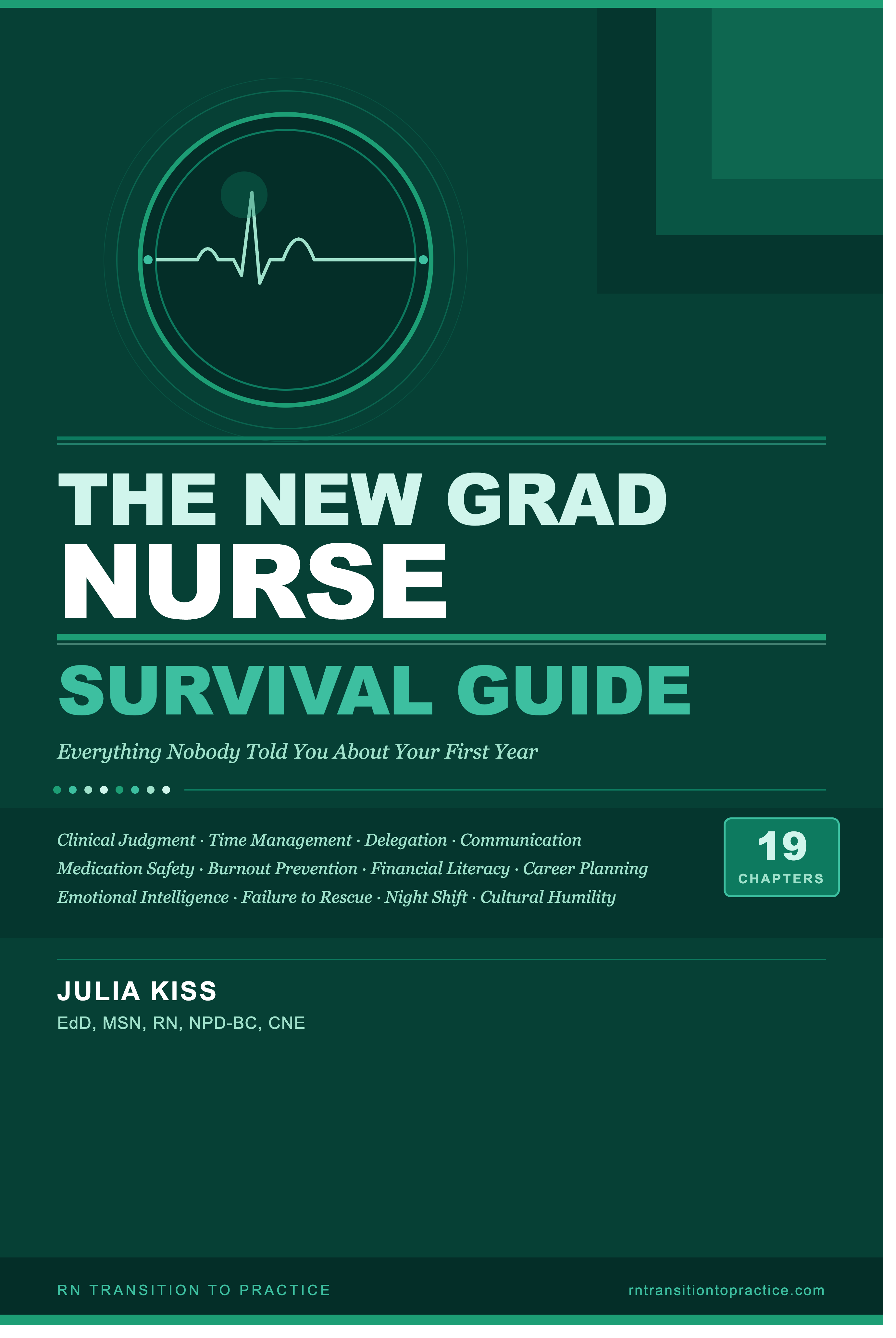
The New Grad Survival Guide
Nursing school prepared you to pass a licensing exam. What comes after that is a different education entirely — one that begins the moment you walk onto the unit as a nurse, and that nobody gives you a syllabus for. The nurses who struggle in their first year are almost never struggling because they don’t know enough pharmacology or pathophysiology. They struggle because nobody taught them how experienced nurses actually think — how they prioritize, regulate their emotions, communicate under pressure, and sustain themselves across a career. Those things are learnable. All of them. This book is where that learning starts. “The transition from nursing student to nurse is not a knowledge gap. It is a cognitive and professional gap. And it is closable.” Across 19 structured chapters, this book addresses the specific things clinical practice requires that nursing school could not fully teach — from the bedside frameworks that experienced nurses use without thinking about them, to the documentation habits that protect your license, to the financial realities nobody mentioned during orientation, to the science of surviving night shift without destroying your health. Every chapter is practical first. There are frameworks, tables, and reference tools — but the real content is specific, usable guidance for real situations: what to say when a patient’s family is angry, what to do when a physician dismisses your concern, how to write documentation that protects you, and how to process your first patient death without carrying it alone.
$19.99 · View product →
From Classroom to Bedside: A Practical Guide to Clinical Judgment and Pattern Re
The gap between nursing school and the bedside is real. This book bridges it. Every new nurse knows the feeling: you studied hard, you passed your boards, you genuinely care about your patients — and you still feel like something is missing. Your preceptor tells you to "think more critically." Nobody tells you what that actually means, or how to do it. This book does. From Classroom to Bedside is a clinical thinking guide built around 30 of the most common and highest-stakes patient presentations in acute care nursing. Not diseases. Not body systems. The actual presentations you encounter when you walk into a patient's room — and need to know what to do. Each chapter teaches you to recognize a clinical pattern, understand what it means, assess how serious it is, act with purpose, and evaluate whether it's working — using the same framework every single time. By the time you've worked through every pattern, the thinking process stops being something you have to consciously recall. It becomes how you naturally approach a patient. What's inside: 30 clinical pattern chapters — sepsis, shock, respiratory failure, altered mental status, acute chest pain, cardiac arrhythmias, stroke, post-operative deterioration, anaphylaxis, and more The Clinical Judgment Framework (CJMM) — the six-step model used by NCLEX NGN, applied to every single pattern so you build the habit automatically Illness Scripts — the prototype presentation, the atypical presentation, and the red flags that change everything Schema Builders — structured critical thinking exercises that teach you to work through clinical decisions systematically, not by memorization Part 3: When the Picture Isn't Clear — five chapters on the hardest clinical moments, when two or more patterns overlap and you have to think your way through 5 comprehensive appendices — Illness Script Master Reference, Clinical Assessment Quick Reference, Critical Safety Parameters and Numbers You Must Know, NGN Alignment and Exam Prep Guide, and Schema Builder Model Answers Who this book is for: Whether you're a nursing student heading into your first clinical rotation, a new graduate in your first year on the floor, or an educator looking for a framework-based clinical judgment resource — this book was written for you. Nursing students: Build clinical judgment before you step onto the unit. Prepare for NCLEX NGN the right way — not by memorizing questions, but by learning to think. New graduate nurses: Close the gap. Get the practical framework your orientation didn't give you. Faculty and clinical educators: A structured, evidence-aligned clinical judgment text you can assign, teach from, or use to build curriculum. Preceptors: A shared language and framework to use with your orientees from day one.
$29.99 · View product →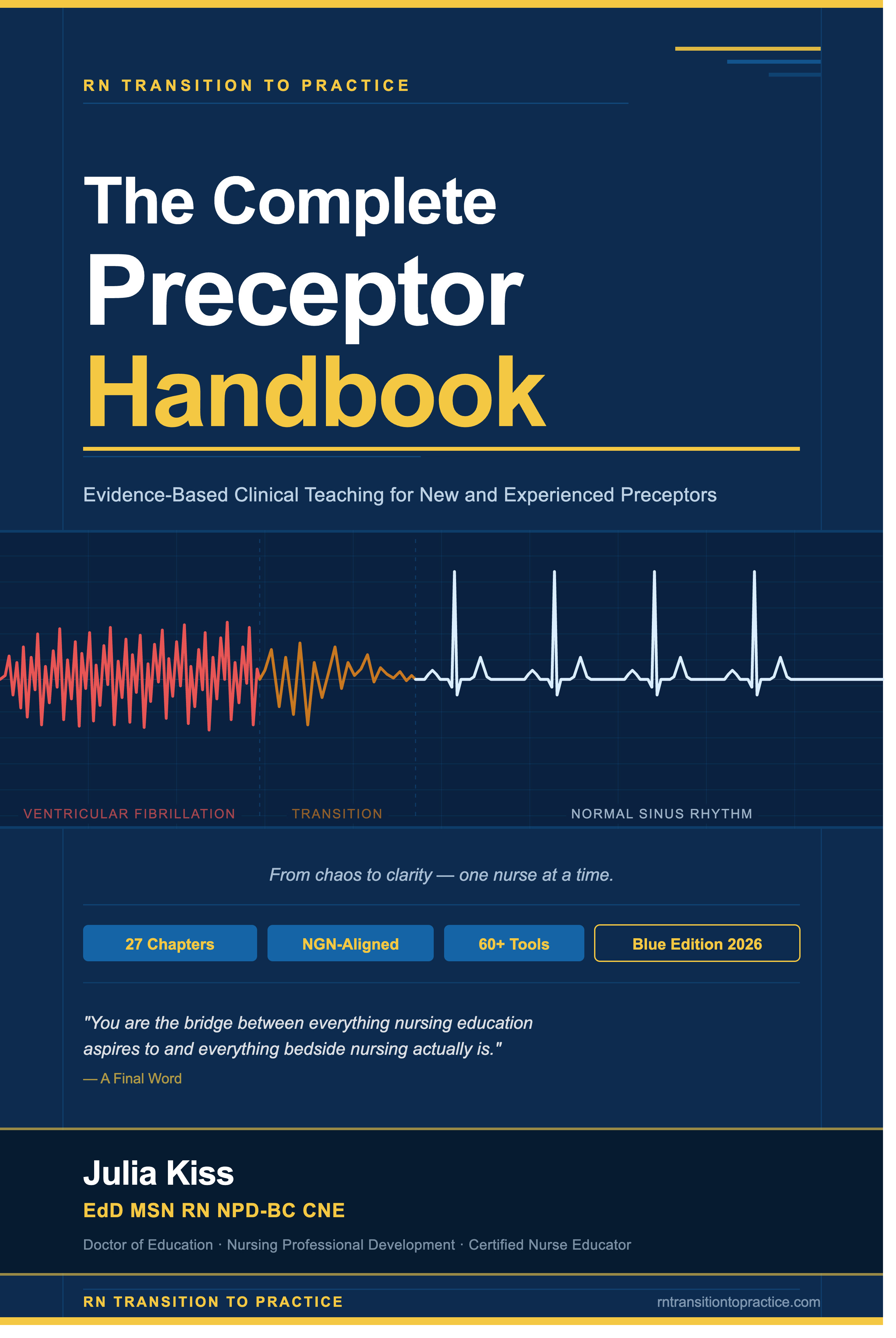
The Complete Preceptor Handbook
Someone raised their hand and asked: "Is there a book for this?" For too long, the honest answer was: not really. Not a book that took the educational science seriously. Not one that acknowledged what it actually costs — clinically, emotionally, professionally — to build another nurse's competence while still being responsible for your own patients. Not one that treated the preceptor as a professional who deserves real preparation, not just a laminated checklist and a good-luck handshake. The Complete Preceptor Handbook is that book. Written by Julia Kiss, EdD MSN RN NPD-BC CNE, it covers every domain of preceptor competency identified by current research — aligned with the NCSBN Clinical Judgment Measurement Model, the NPD Scope and Standards, and the latest evidence on how adults actually learn. 27 Chapters · 9 Appendices · 90+ Citations What you will find inside The New Graduate Reality Transition shock, its three stages, and what CBE, NGN, and simulation actually prepared your orientee for — and what they didn't. Clinical Judgment & NGN The NCSBN CJMM mapped to orientation milestones, with NGN-aligned teaching strategies for every layer from noticing to reflection. Feedback That Changes Behavior SIGN model, One-Minute Preceptor, SNAPPS — and documentation that protects you legally when an orientee is struggling. Specialty Precepting Models ICU, Emergency, Pediatrics, OR, Behavioral Health, and Med-Surg — what is genuinely different in each setting and why it changes how you teach. Legal Responsibilities Scope of practice, co-signature liability, mandatory reporting, HIPAA, and professional boundaries — clearly explained without legal jargon. Your Own Wellbeing Compassion fatigue, boundary-setting, and how to sustain your clinical identity across orientation after orientation. This handbook is for you if You do this work You were handed your first orientee with minimal preparation and figured it out as you went You have been precepting for years and still want to understand why some things work and others don't You have a struggling orientee right now and need a framework for what to try next You are a unit educator or NPD practitioner building an orientation program that actually holds You believe the nurse you are building will matter for decades — and you want to do it well By the numbers One handbook.Everything you need. 27 Chapters 9 Appendices 90+ Evidence-based citations 60+ Clinical tools Julia Kiss EdD MSN RNNPD-BC CNE Doctor of Education Nursing Professional Development Certified Nurse Educator rntransitiontopractice.com About the author Written by someone who has done the work Julia Kiss holds a Doctor of Education, a Master of Science in Nursing, and dual certifications in nursing professional development (NPD-BC) and nursing education (CNE). Her career sits at the intersection of clinical practice and education — studying how nurses learn, how preceptors teach, and what actually closes the gap between what new graduates know and what bedside nursing demands.
$19.99 · View product →
Before the Alarm
Before the Alarm Learning Science, Clinical Judgment, and AI in Nursing Education Julia Kiss, EdD MSN RN NPD-BC CNE Most nurses who become educators were never taught to teach. They were excellent clinicians — and they made the classic mistake of assuming expertise transfers automatically into the classroom. It doesn't. This book explains why, and what to do about it. Drawing on cognitive science research and thirty years of clinical nursing experience, Before the Alarm maps the gap between what nursing programs deliver and what clinical practice actually requires — and gives educators the frameworks and tools to close it. Each of the sixteen chapters covers one foundational idea and closes with three practical tools you can use in your next class. This book is for Nurses transitioning into faculty or educator roles who want a grounding in how learning actually works Experienced nursing educators who sense something isn't adding up — students passing but struggling in clinical Program directors building curricula around clinical judgment, the Next Generation NCLEX, and AI-integrated practice
$19.99 · View product →
Student Success in Nursing School: A Complete Guide to Learning, Thinking, and T
Nursing school will test everything you think you know about learning. The volume is relentless. The clinical stakes are high. And the exams don't test what you think they do. Success here isn't about memorizing more — it's about learning differently. Student Success in Nursing School is the complete guide every nursing student needs from day one — written by a registered nurse who has been there. This is not a question bank or a last-minute NCLEX cramming tool. It is a comprehensive, chapter-by-chapter guide to every dimension of the nursing school experience. Inside you will find: How to study smarter — the science of memory, retention, and active learning Clinical reasoning, critical thinking, and the NCSBN Clinical Judgment Model explained clearly NCLEX 2026 and Next Generation NCLEX (NGN) test-taking strategies that align with how nurses actually think Pharmacology made manageable — a learning system that actually sticks How to navigate clinical culture, speak up safely, and handle lateral violence Managing compassion fatigue, moral distress, and burnout before they manage you Prioritization frameworks, time management, and surviving the clinical environment What to do when you are struggling — including support for first-generation and diverse students. Whether you are just beginning nursing school, fighting to stay afloat mid-program, or preparing for licensure, this book meets you where you are. It is the guide you wish someone had handed you on day one. Julia Kiss, RN, is a registered nurse with clinical experience across multiple specialties and a deep commitment to nursing education and student success.
$19.99 · View product →
Burnout Prevention Guide
What is inside the 15 pages: What burnout actually is (and isn't) The burnout self-assessment Daily habits that prevent it Moral distress: the hidden driver Boundaries: what to say when The recovery plan: if you are already there Your weekly burnout check-in
$4.99 · View product →Role Transition & Identity Formation
What is inside the 15 pages: The transition reality no one discusses The emotional arc: what to expect when What competency looks like at 30-60-90 days Anxiety & impostor syndrome Realistic expectations guide Identity formation: Becoming a nurse Your transition journal & tools
$4.99 · View product →Interprofessional Communications
What is inside the 15 pages: Why communication is the highest impact clinical skill SBAR mastered: from format to fluency Communicating with each provider type Saying I need help early: the script Barriers that silence nurses --- and overrides Giving and receiving feedback Handoff, difficult conversation, and daily practice
$4.99 · View product →Failure to Rescue: A Practical Guide for New Grad Nurses
What is inside the 14 pages: What failure to rescue is.... exactly The cascade: how patients deteriorate The 7 early warning sign clusters Barriers that stop new grads from acting Bedside rescue scenarios The escalation scripts that work Building your surveillance habit
$4.99 · View product →Workplace Incivility, Bullying, & Harrassment
What is inside the 16 pages: The landscape: what is really happening The spectrum: Incivility to harassment In the moment response skills Documentation and building your case Escalation path and process Protecting your mind and career Your rights, resources, and support
$4.99 · View product →Thinking Like a Nurse
What is inside the 15 pages: The fundamental cognitive shift From knowing to reasoning: how nurses think The 6 thinking shifts you must make mental models for clinical decision-making Thinking under pressure and uncertainty Building your clinical voice The daily thinking practice
$4.99 · View product →Surviving Night Shift
What is inside the 16 pages: The night shift reality: what you are up against Sleep science for rotating shift workers Before, during, and after the shift Clinical confidence at 3 am Alertness and safety strategies Social life, relationships, and isolation The transition off night shift: what to do now
$4.99 · View product →Documentation & License Protection
What is inside the 15 pages: Why your documentation is your license The 7 rules of defensible documentation High-risk scenarios & Exact language Medication errors, near-misses When physicians or other providers dismiss you Protecting your license: what to know If you are reported to the board
$4.99 · View product →Building Confidence
What is inside the 16 pages: Why practical skills build confidence Communication skills that work Clinical organization and ownership Asking for help and learning fast Handling mistakes and hard days Body language and professional presence Your 12-week skill-building plan
$4.99 · View product →Clinical Judgment: A Practical Guide
What is inside the 14 pages: What clinical judgement actually is The five-layer judgment model Pattern recognition skills The clinical thinking habits Bedside scenarios and drills When to escalate & when to wait Building your judgment over time
$4.99 · View product →Med-Surg Shift Brain Sheet with Reprioritization Framework
When the shift goes sideways, the reprioritization framework Four patient accountability and shift checklist Protips
$4.99 · View product →